
Summary
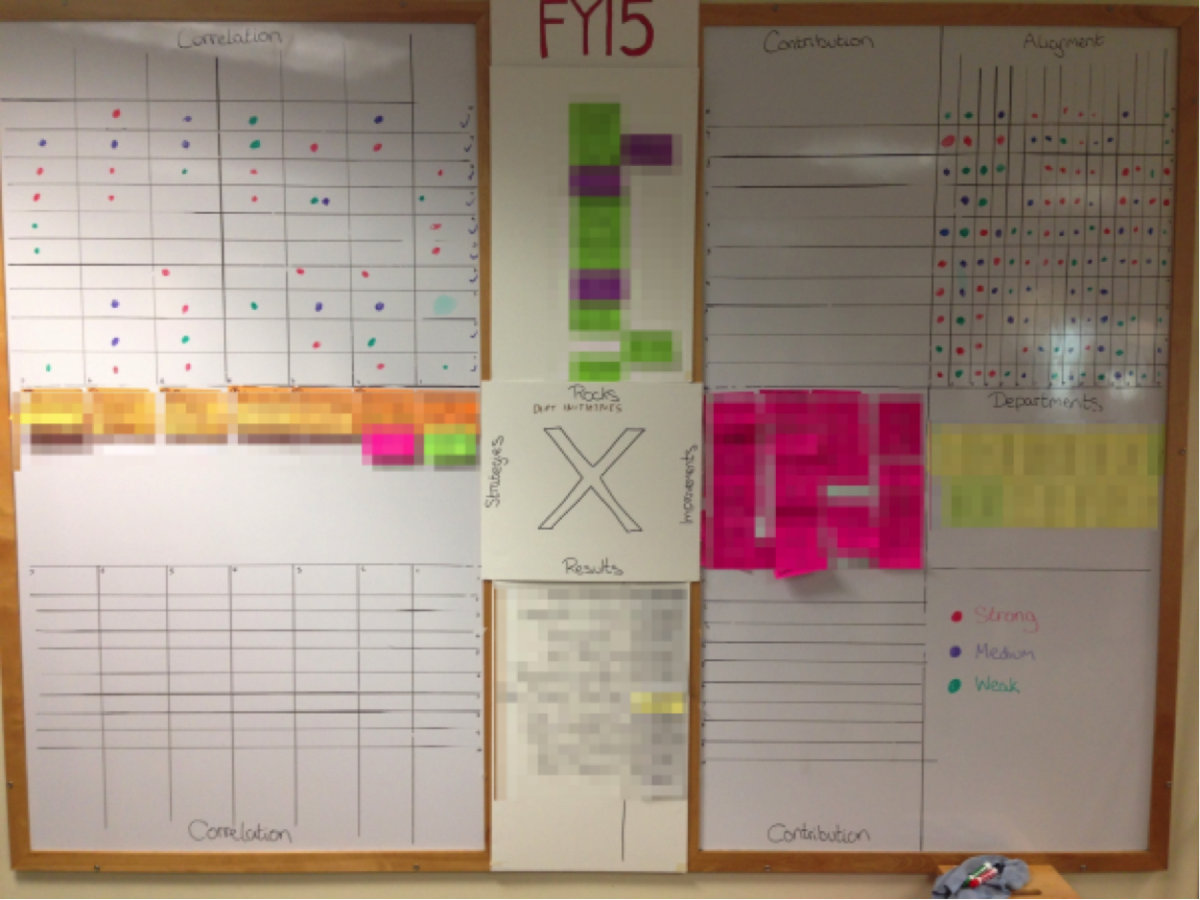
As Rally Software grew past 500 people, it added the X-Matrix to its use of Strategy Deployment, so that strategy reached more people who couldn’t be in the room. A two-day Annual Planning event with around 80 staff and customers produced a one-page plan: the strongest strategies, the top 10 initiatives, and the measures to track them, reviewed every quarter. As an Agile coach in Rally’s Office of the CTO, I helped design, prepare, and facilitate the Annual Planning and Quarterly Steering sessions.

Situation
Rally Software was a scale-up selling cloud-based tools for managing Agile software development. Between 2010 and 2014, it grew from a few hundred people to past 500, and was later acquired by CA Technologies.
I’m Karl Scotland. I joined Rally in 2010 as an Agile coach for the EMEA region, and in 2013 moved to the Office of the CTO, where I got involved in the operating model and Strategy Deployment work. I left in 2014 and carried on working for Rally as an independent Agile coach.
Rally already ran Strategy Deployment, using Strategic A3s based on Pascal Dennis’s Getting the Right Things Done. In 2013, it began experimenting with the X-Matrix from Thomas L. Jackson’s Hoshin Kanri for the Lean Enterprise.
The challenge
As Rally grew past 500 people, the dynamics changed. The way it ran Strategy Deployment, which had worked well at a few hundred, was getting harder to sustain. The problem was engagement. Strategy was shaped in the room, and the people in the room were a shrinking share of the company.
Annual Planning and Quarterly Steering were where strategy was worked on, and those sessions stayed about the same size while the company kept growing. Rally liked experimenting with new ways of working, so it tried the X-Matrix: the whole plan on one page, which people who hadn’t been in the room could still read and respond to.
The Approach with the X-Matrix
Rally added the X-Matrix to its existing quarterly planning cadence. It became the single page that connected the company’s strategy to every department’s work.
- The existing operating model. Rally already ran a quarterly planning and steering cadence around an annual plan with a True North (one statement of where the company wanted to be by year-end), no more than four Mother Strategies, and a small set of cross-departmental initiatives called Rocks.
- The X-Matrix. Based on Thomas Jackson’s Hoshin Kanri for the Lean Enterprise, it explicitly linked the business results Rally already tracked and shared openly to its strategies, and added the measurable improvements that would track progress. It also showed how strongly each Rock contributed to each strategy, and which departments led or supported each Rock.
- Strategic A3s. Each Rock or department team described its plan on one page: past performance against targets, reflections, interpretation, then a quarterly plan, next steps, risks, and dependencies.
- Quarterly Steering. Teams revised their A3s each quarter as results came in, and the updated A3s, along with the X-Matrix, were the focus of Quarterly Steering.
Rally adapted the technique rather than adopting it wholesale, and changed the terminology to fit its own context (see How Rally Does Strategy Deployment).
Working with the leadership team
We built the first X-Matrix at a two-day, facilitated Annual Planning event with around 80 people: about 70 staff from across the business and 10 invited customers (see How Rally Does Annual and Quarterly Planning).
I helped design, prepare, and facilitate the Annual Planning and Quarterly Steering sessions. I also helped design Rally’s service offerings for teaching customers the same Strategy Deployment approach.
| Day | Focus | What happened |
|---|---|---|
| 1 | Divergence | A retrospective on the current year, working individually, in pairs, then in departments. The executive team then presented its proposed strategies, followed by Open Space breakouts exploring Rocks and improvements. |
| 2 | Convergence | Groups formed around each proposed strategy and pitched Rocks to three executives, who accepted them with a chime or rejected them with a horn. Rejected pitches were reworked and pitched again, until the top 10 Rocks were agreed. Groups then re-formed by department to record accountability, and a final Open Space agreed the actions needed to validate the plan. |
Directors and above attended every time, and other staff took turns, so each event mixed regulars with new voices. Customers joined the breakouts and worked alongside staff throughout, apart from a confidential opening session.
We ran the event a quarter before the new financial year. That left time to test the draft plan before the year began, and for the executive team to use the X-Matrix to narrow it down to the strategies and Rocks with the most leverage.
The same style carried down into the teams. When one fast-growing international team needed its own Strategic A3, I facilitated a one-day session in Rally’s Amsterdam office. Small regional groups drafted A3s, the whole team themed the results in silence and dot-voted on them, and then agreed the top three items to raise with the wider business at the next steering cadence.
Key decisions from the X-Matrix
The input and feedback gathered on the X-Matrix helped answer three questions.
- Which strategies were strongest? The executive team narrowed the proposals to no more than four Mother Strategies.
- Which tactics would implement them? Annual Planning agreed on the top 10 Rocks, and Rally limited how many were in progress at once.
- Which measures would show progress? Each Rock was tied to business results and measurable improvements, which Quarterly Steering then reviewed.
Rally’s terms (True North, Mother Strategies, Rocks) predate my later TASTE framework.
Outcome
The X-Matrix became part of Rally’s planning cadence and was used for more than one annual cycle. Everyone in the company could see the work on one page, along with why it mattered and how progress would be measured.
- At the time, I called it a clear success because it brought discipline about measures and results and showed how all the work was aligned (see How Rally Does Annual and Quarterly Planning).
- It was also a period of fast growth. Rally went public on the NYSE in April 2013, raising $84 million (NYSE, Renaissance Capital). In May 2015, it agreed to be acquired by CA Technologies for $480 million (Feld Thoughts).
I’m not claiming the X-Matrix caused the IPO or the acquisition. But it does show Strategy Deployment working inside a fast-growing, newly listed software company.
Lessons from the X-Matrix
Three lessons from Rally shape how I work with leadership teams today.
- Collaboration matters more than the document. The X-Matrix worked because people built it together, in the room and through feedback, so it never felt like another planning document handed down from above.
- Diverse voices make a better strategy. Rally drew on the breadth and depth of the organisation, from directors to people taking their turn at planning, and invited customers to work alongside staff.
- Experiment and learn. There is no one right way. Rally made the X-Matrix fit its own context, and kept adjusting it as it learned.
Why this matters for clients
My independent work follows the same idea. Strategy stays connected to execution when the people doing the work help build it, and keep reviewing it together.
- A first X-Matrix in a few weeks. We build it together with the leadership team and the wider organisation. I don’t hand over a consultant’s document.
- A regular steering cadence. Optional check-ins and working sessions, then a steering workshop after the first quarter, so the strategy is reviewed and refreshed with everyone taking part.
- Context-specific, not prescriptive. I don’t have a methodology to install. I adapt the approach to each organisation, as Rally did for itself.
- Built to stand on its own. I’m more involved early on, then lighter touch, so the organisation owns its operating model rather than depending on an outside consultant.