
The Scrum Guide Expansion Pack was first released in June 2025, and I was one of several people to provide feedback. In particular, my suggestion was to improve the way that strategy was defined and described. That led to further conversations and eventually an opportunity to create a separate document that focused solely on Strategy and Strategy Deployment, or Continuous Strategy.
The goal was to provide a high-level summary and overview of what Scrum Teams would find useful to know about Continuous Strategy. Scrum, and the original Scrum Guide, is deliberately incomplete, and the intent is not make strategy part of Scrum. However, by creating the document, we can offer some pointers to relevant topics, tools, and techniques that may help Scrum Teams be more effective.
The team behind the expansion pack (Jeff Sutherland, John Coleman, and Ralph Jocham) published the document last week.
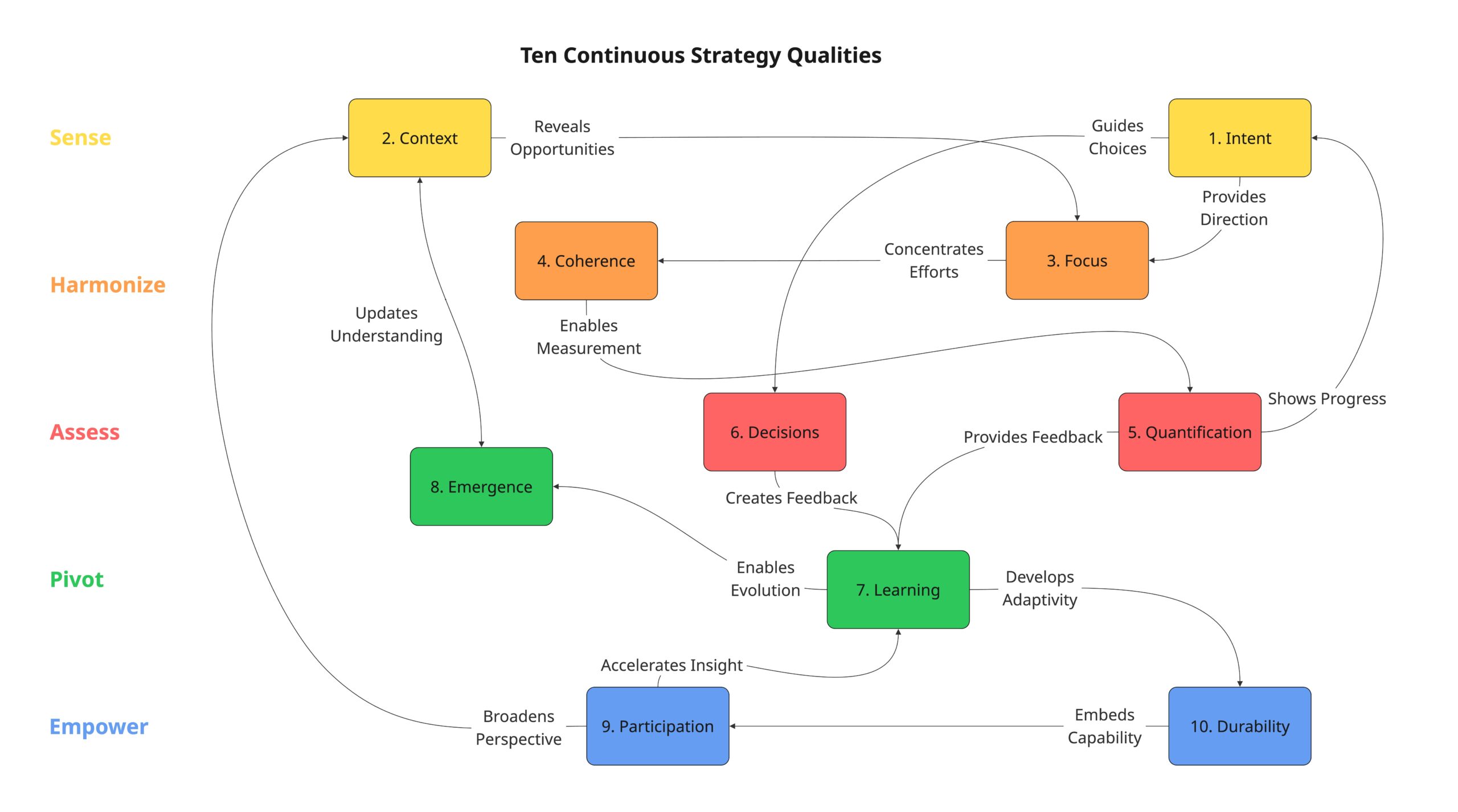
The content was created by brainstorming and then theming the various ideas to be included. The result was 10 qualities of Continuous Strategy, as shown in the image. Note that they are not qualities to always dial up to eleven (“Extreme Strategy”). Instead, they are qualities with which to assess and improve strategy. You may choose to increase or decrease a quality depending on circumstance.
The Ten Qualities
Those qualities are (with the number being for reference, but not linearity):
- Intent – does the strategy provide direction without dictating solutions?
- Context – is the strategy unique to specific conditions?
- Focus – does the strategy focus on how to win?
- Coherence – does the strategy align work for maximum impact
- Quantification – can the pursuit of the strategy be visible and measurable?
- Decisions – does the strategy enable choices of what to do, and what not to do?
- Learning – does the strategy enable and create new knowledge and insights?
- Emergence – does the strategy adapt as a result of new learning?
- Participation – does the strategy mobilise collective intelligence and experience?
- Durability – will the strategy survive leadership changes?
The SHAPE of Continuous Strategy
If you’re eagle-eyed, you’ll also notice that those qualities are also grouped into pairs to form the acronym SHAPE. This provides a nice way of helping remember the qualities, and I like the idea of SHAPEing strategy as an active exercise, rather than a one-off static event.
- Sense – Intent and Context
- Harmonise – Focus and Coherence
- Assess – Quantification and Decisions
- Pivot – Learning and Emergence
- Empower – Participation and Durability
This document will continue to evolve and improve over time. There are already a number of updates I want to make. If you have any feedback, you can leave a comment here or start a discussion on the main GitHub site
[…] The Continuous Strategy Scrum Guide Expansion Pack is Now Here (Karl Scotland) […]