Karl Scotland – Using Agile to Deliver Value
Archive for December, 2010
Kanban and Systems Thinking
Dec 22nd
Systems Thinking
The original Agile methods were created by teams independently in response to the challenge of improving software development and their documentation as a named process was a subsequent codification in order to help spread the learning and improvement wider throughout the industry. Either consciously or intuitively, these processes were applications of Systems Thinking, taking a holistic approach to solve the problem at hand. Taken in this context we can learn from Agile methods by treating them as system archetypes rather than repeatable solutions, and design our own systems to create the same results.
System Structure
Systems Thinking suggests that systems are made up of elements, which interact, to meet a purpose. In other words, they are more than the sum of the parts.
- A system’s purpose is what ultimately determines its behaviour. In fact a system’s purpose can be often deduced from its behaviour which is observed over time rather than through individual events. A generic purpose for product development might be to deliver value through achieving flow and building capability.
- A system’s elements are the things that it is made up of and these can be either tangible or intangible. Tangible elements of a product development system could include the people, physical resources (e.g. hardware and furniture) and artefacts (e.g. specifications and tests). Intangible elements could include the software itself (both product and tests), software tools (e.g. compilers and editors), skills and morale.
- A system’s interactions are the relationships that hold its elements together. They can typically be a flow of energy, material or information. For product development systems, the most relevant interactions often take the form of information flows. This might be information about learning (e.g. success or failure), state changes (e.g. ready or done) or decisions (e.g. accepted or rejected).
System Archetypes
A system can also be described in terms of stocks and flows. A stock is a recognisable and measurable part of the system, and the flows are what cause the stock to rise and fall over time. Thus, the stock at any given time is the result of the all the preceding flows in and out of the system. The stock acts as a buffer for the flows, which can create stability and allow for variability by decoupling the flows. However, it can also cause delays which may cause instability. In a product development system, if we think of the stock as the Work in Process (WIP), we can see that some WIP will create stability, but too much will create undesirable delays.
Describing systems in terms of stocks and flows leads to the understanding of feedback in systems. Feedback is created when changes in a stock affect the flows into or out of that same stock. Feedback can either balance and stabilise, or reinforce and amplify a system’s behaviour and combinations of feedback structures result in a system’s behaviour being constant over time. The patterns which cause similar and recognisable system behaviour are known as system archetypes.
Kanban Systems
These basic Systems Thinking concepts give us a clue to how we can help meet the challenges of improving our product development practices without codifying methods. Having clarity of purpose, and the way elements interact to achieve that purpose, can give us insight into intervention points for continuously improving.
System archetypes give us a further perspective with which to view our product development processes, and suggests the role Kanban plays. If Agile processes are examples of a system archetype, then Kanban provides an approach to creating further examples of those system archetypes. Workflow can be thought of as part of the system structure. Visualisation can highlight key elements and interactions. Limiting WIP can manage the stock. Cadence can co-ordinate of elements and interactions. Learning can focus on improving the system. Further, where processes are exhibiting less desirable archetypes, then Kanban provides an approach to recognise, visualise and eventually break them.
It should be remembered though that systems area non-linear in that there not a simple cause and effect relationship. That is why behaviour should be measured over time rather than looking at individual events. As Donella H. Meadows so eloquently put it in her book ‘Thinking in Systems: A Primer’, “The future can’t be predicted, but it can be envisioned and brought lovingly into being” and “We can’t control systems or figure them out. But we can dance with them!”
People and Process: Two Sides of the Same Coin
Dec 18th
I wrote this short article for JAX Magazine, but it seems JAX doesn’t want to make it easy for people to access the content (you have to register to get a download link which only works once). So I’ve decided to post the article here as well. Its an evolution of some of my thinking that goes back to the new lean and agile picture I posted.
One of the value statements from the Agile Manifesto is “individuals and interactions over processes and tools”. This is often abbreviated to “people over process” with a common interpretation being that the human aspects of software development are the primary areas we should be focussing on for improvement. However, this is counter to the ideas of W. Edwards Deming, who said “a bad process will beat a good person every time”. Similarly, Don Reinertsen has said he prefers “people times process” because if either is zero, then the product is zero.
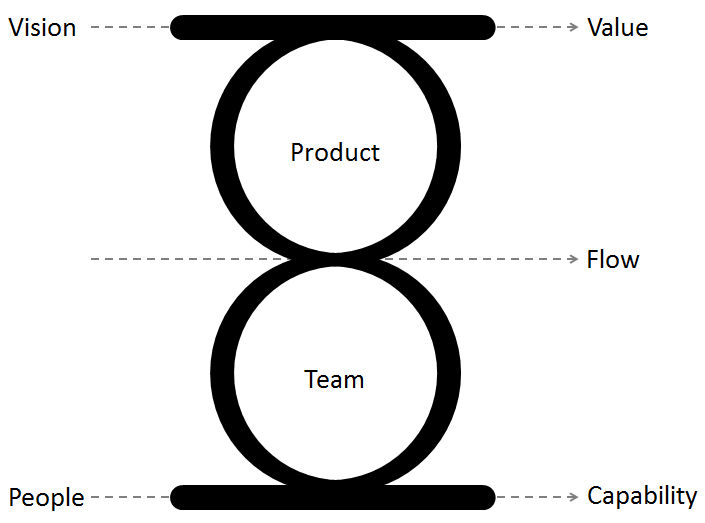
People and process are two sides of the same coin, both equally important in understanding how to improve capability to deliver valuable software.
People
This side of the coin is about taking a group of people, who form a team in order to develop a capability. Peter Senge wrote in ‘The Fifth Discipline’ that “the fundamental learning units in an organisation are working teams (people who need one another to produce an outcome)”. Creating teams in this way allows people to iteratively learn about the way that they work so that they can incrementally develop their capability in order to improve the outcomes that they produce.
This is the basis of all the popular Agile methods such as Scrum or Extreme Programming, which all recommend creating cross-functional and co-located teams, collaborating with high bandwidth communication. Thus, the people side suggests that forming outcome-focussed teams, rather than activity-focussed silos, will result in an improvement.
Process
This side of the coin is about taking a vision, which is developed into a product in order to deliver value. Mark Denne and Jane Cleland-Huang wrote in their book ‘Software by Numbers’ about “an ROI-informed approach to software development in which software is developed and delivered in carefully prioritized chunks of customer valued functionality”. Taking this approach means that a product will maximise its value through being iteratively refined piece by piece in order to incrementally deliver functionality.
This is the basis of Lean approaches such as Kanban, which focuses on creating an explicit understanding of the process in order to learn how to deliver valuable pieces of software more effectively by modelling and visualising the work and associated policies. Concepts such as Minimal Marketable Features and User Stories help break down the work into smaller pieces. Thus, the process side suggests that continuously delivering small pieces of functionality with minimal delays, rather than waiting to release large batches of features, will result in an improvement.
People and Process
It is when we put these two sides together that we can achieve significant improvement. The iterative loops of learning about both the team and the product link into each other enable product value to rapidly flow through capability teams. This is the development nirvana we are trying to reach.
This model also gives some insight into why the “Waterfall” model, described by Winston Royce in his 1970 paper ‘Managing the Development of Large Software Systems’, has proved to be unsuccessful. It is not because the simple work-flow described was inherently wrong, but because the work-flow has typically been implemented with specialist silos rather than capability teams, and with large rather than small batches. It is both these two sides of the coin that should be the focus of learning and improvement in order to help us on our journey to the nirvana of product development flow.
Kanban System Design Article
Dec 10th
I’ve just had an article published on Agile Journal about Kanban System Design in which I look at Kanban from a Systems Thinking perspective, and how various aspects of Kanban can provide leverage points to improve our product development outcomes.
Lean Software & Systems Conference CfP & Registration Open
Dec 5th
The Lean Software and Systems Consortium US-based community conference will be May 3-6 next year, in Long Beach California. The Call for Papers and Registration are now open. The CfP Deadline is Dec 19th and will not be extended.
May 3rd is LeanSSC Technical Advisory Board meeting and pre-conference tutorials. If you intend to attend those you should plan on arriving in Long Beach on May 2nd. The full conference starts on May 4th.
The Lean Software and Systems Conference is the Kanban conference for North and South America in 2011. This is where the community gathers and is where you will get the first chance to see and hear the best new material.
We will also be awarding the Brickell Key Award for outstanding achievement, leadership and community contribution for the 2nd year. A Call for Nominations will be made within the next week. Please consider who you’d like to nominate for the award. Last year’s worthy winners were David Joyce and Alisson Vale. This year they, together with David Anderson, Alan Shalloway, Donald Reinertsen and I, make up the selection committee. The Award banquet will be held on Thursday May 5th in Long Beach. Be sure to select the banquet as part of your registration if you would like to be part of ceremony and festivities.
Volcanoes and other natural disasters or Black Swans permitting, I hope to see you there.